Vicarious Trauma and Coping Strategies Among Aid Workers: A Qualitative Study

Senior Psychologist and Staff Wellbeing Specialist // DIANA CHEPKOSGEI
DIANA from our team recently completed her thesis on how witnessing the trauma of others impacts international humanitarian workers. Here, she unpacks her research and findings.
What drew you to this topic?
Working at Thrive as a Staff Psychologist, I journey alongside clients who work in the aid sector. Listening to their stories, I kept thinking — this is such a huge sacrifice. You’ve left your family. You’ve gone to a remote, often dangerous part of the world, sometimes for years at a stretch. And I was genuinely curious: what does that do to your mind? How do you see the world and other people differently?
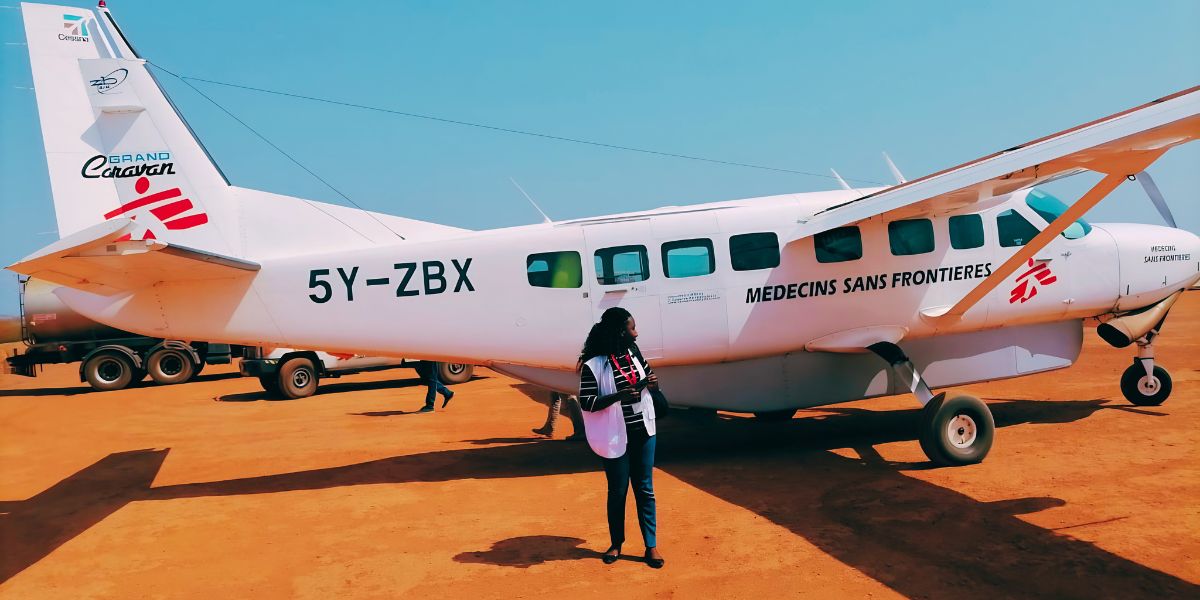
I also did missions with Médecins Sans Frontières (MSF), so I experienced it firsthand — being in a tent in a remote area while there’s violence around you, still showing up, still supporting staff. And I was only there as a consultant for a short period. What about someone on a six-month or year-long deployment? That planted a seed I had to follow.
Tell us about your thesis.
In it I explore the intersection of vicarious trauma and coping strategies among international humanitarian aid workers, with a specific focus on Juba, South Sudan. At its core, it was about understanding the lived experiences of these workers — people who show up every day in volatile, complex environments to support communities in crisis — and how witnessing trauma over time affects their own mental and emotional wellbeing.
How did you conduct your research?
I used a qualitative approach which focused on subjective, lived experiences — so in-depth interviews were essential. I connected with participants through former colleagues and referrals from my networks, and conducted one-hour virtual interviews with each person.
I had seven to eight participants in total — a mix of three men and five women, mostly Kenyan, with participants from Rwanda and the US as well. My main criteria was that they had worked for at least one year in the sector, though I prioritised people who had done five or more years across multiple global missions. Before the interview, I also had each person complete a validated assessment tool to measure vicarious trauma symptoms.
What did you find?
Every single participant presented with symptoms of vicarious trauma — though at different levels of intensity. For me, that confirmed it: this is an occupational reality, not an exception. You cannot be immersed in suffering day after day and come out untouched.
There’s a researcher called Dr. Rachel Remen who puts it beautifully: “The expectation that we can be immersed in suffering and loss daily and not be touched by it is as unrealistic as expecting to be able to walk through water without getting wet.” That’s vicarious trauma. You absorb elements of it whether you intend to or not.
In terms of how it showed up, participants experienced changes in sleep, shifts in worldview, and heightened vigilance around security. Many became more skeptical. But there was also a positive dimension — a deep appreciation for what they had back home, for infrastructure, for safety. So it wasn’t entirely bleak. It was a complex, layered shift.
This is an occupational reality, not an exception: you cannot be immersed in suffering day after day and come out untouched.
Does the amount of exposure make a difference?
This surprised me, honestly. It’s not so much about how much you’ve been exposed to — it’s about what protective factors you have in place. One of my participants was a nurse in her late 60s who had completed over 30 missions. By any measure, she’d seen a lot. But what kept her going was a profound sense of purpose and calling, a deep faith, and a genuine joy when she saw her patients recover and thrive. She was doing remarkably well.
Compare this with someone who has 10 years of experience, yet is deeply impacted by a single traumatic incident because they lacked the internal and external structures to process it. It’s not simply about exposure or time in the field—the structures around you, and within you, can significantly shape how you experience and respond to trauma.
What coping strategies stood out from your research?
This was one of the parts of my research I found most compelling. Yes, people used the more familiar strategies like therapy and journaling, but I was particularly interested in informal coping strategies, and three stood out. Most participants traced their resilience back to their relationship with a higher power — God, the universe, whatever they believed in. This is still quite under-researched in mental health science, but the correlation was hard to ignore.
Community was equally powerful. People spoke about weekends with colleagues, playing games together, building peer support systems organically. In environments where formal support is limited, that communal bond becomes a lifeline. Physical activity also came up repeatedly — not just working out, but dancing, walking, anything that gets the body moving and creates an outlet. I realised that we don’t need to rely solely on Western models of coping. There is real value in making room for culturally relevant, informal strategies that people are already using.
This surprised me, honestly. It’s not so much about how much you’ve been exposed to — it’s about what protective factors you have in place.
What should organisations be doing better to support those they send to complex environments?
First, this cannot be an individual responsibility. Organisations need structured systems of support before, during, and after deployment — resilience checks before a mission, mid-assignment reviews, and proper psychological support after. Staff should never feel like they have to manage this alone.
I also think that organisations need to become trauma-informed. That means training managers and leaders to recognise the signs of vicarious trauma in their teams, having clear protocols when a traumatic incident occurs, and ensuring access to mental health professionals or wellbeing champions on the ground. And finally, make room for informal coping. Can staff observe prayer times? Is there space for meditation or faith-based community gatherings? These aren’t soft extras. For many aid workers, they are the very things keeping them whole.
Explore our new self-led e-learning course on Vicarious Trauma Awareness to learn how contact with the suffering of others can impact you, and what you can do about it.